
Mass events in Poland: thresholds and 2027 changes
November 24, 2026
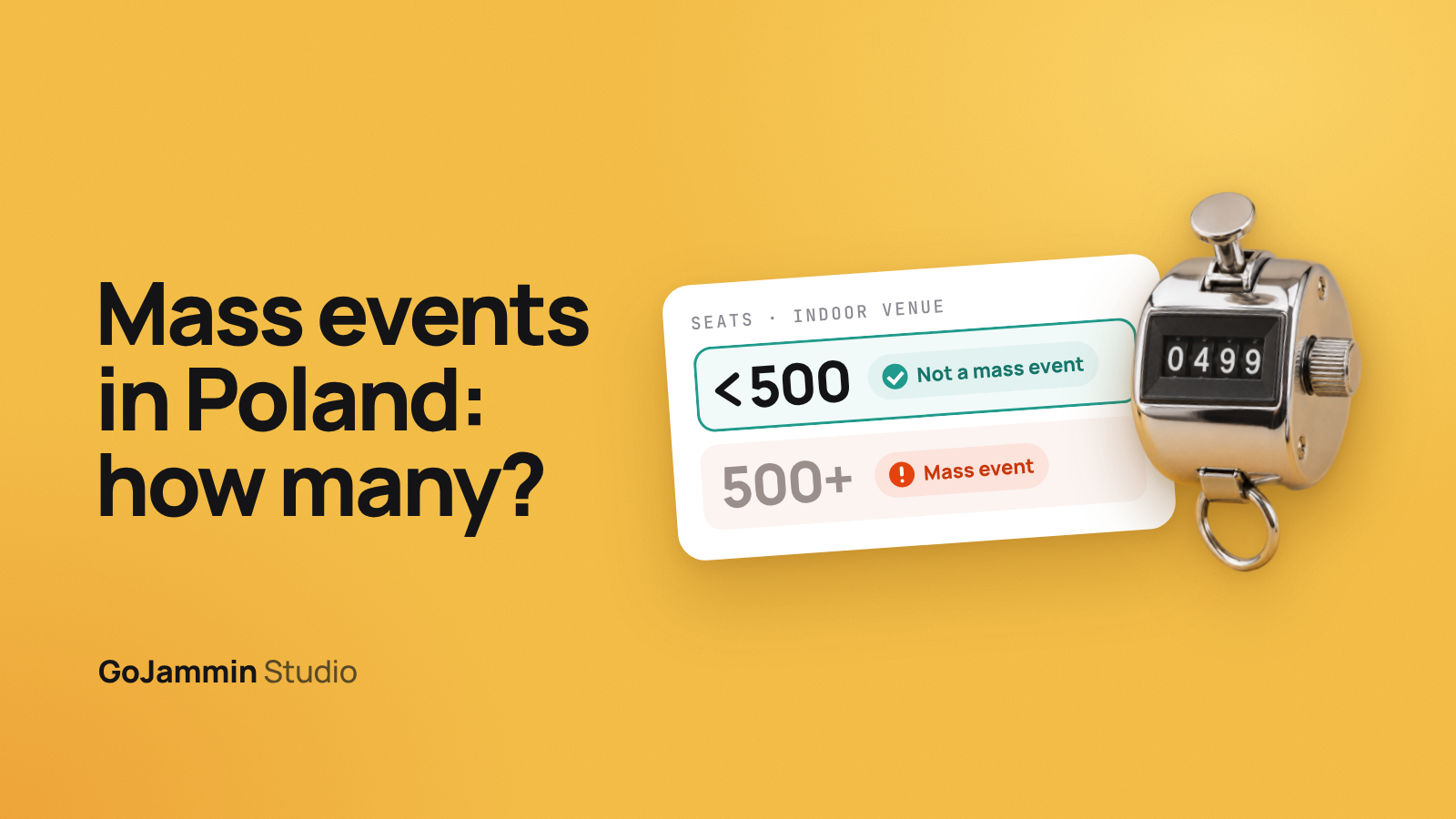
A mass event (impreza masowa) is an artistic, entertainment or sports event that falls under the Polish Mass Events Safety Act of 20 March 2009 because of the number of places it makes available. Whether your event counts as a mass event decides whether you need a permit from the head of the municipality (wójt, burmistrz or prezydent miasta), security and information stewards and, if entry is paid, liability insurance. Holding a mass event without a permit is a criminal offense.
From 1 January 2027 a new procedure applies to artistic and entertainment events: if the office does not issue a decision at least 7 days before the event, the permit is deemed granted on the terms of your application. The thresholds that make an event a mass event stay the same.
How many people make a mass event
The threshold depends on the type of event and on whether it takes place in a building or in an open area (art. 3(2)–(4)).
| Type of event | Mass event from |
|---|---|
| Concert or other artistic or entertainment event in a hall or other building | 500 places |
| Concert or other artistic or entertainment event at a stadium or in an open area | 1,000 places |
| Sports event in a sports hall or other building | 300 places |
| Sports event at a stadium or in an open area, including a football match | 1,000 places |
Organized public viewing of a TV broadcast on a screen larger than 3 m diagonally, such as a fan zone, also counts as an artistic and entertainment event.
Lower thresholds apply to high-risk mass events, where information about threats or past experience suggests a risk of violence or aggression: 300 places at a stadium or in an open area and 200 places in a hall or other building (art. 3(5) and art. 7). The office states in the permit that an event is high-risk, for example based on a police opinion (art. 29(3)).
The Act covers only artistic, entertainment and sports events. A conference, training or trade fair is not a mass event, however many places it has. A concert or gala with an artistic program at a conference is an entertainment event, so if it has 500 or more places in a building, treat it as a mass event.
How to count places at an event
You count places under building and fire safety regulations (art. 3(7)). In a building the upper limit is the maximum number of people allowed in the venue, which the venue manager gives you.
You don't have to make every place in the hall available. What counts is the seat pool you set: tickets on sale, invitations and guest-list places together. The number of tickets you actually sell makes no difference.
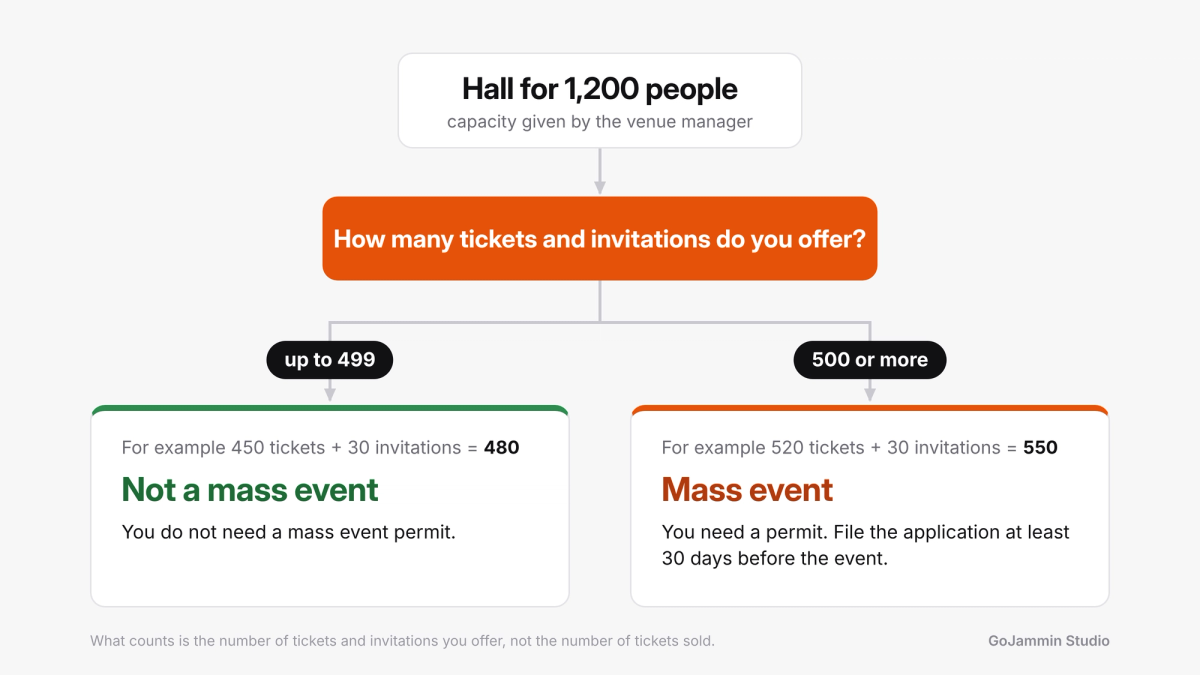
Write the pool into the event rules and stick to it in sales and at the door. If the office or the police inspect the event, they will assess the number of places on exactly this basis.
In an open area the Act assumes 0.5 m² per person (art. 3(14)), that is 2 people per 1 m². The 1,000-place threshold therefore equals 500 m² of area set aside for the audience, for example a 20 × 25 m square.
If you don't limit the number of people coming in, for example at a free concert without passes, the area decides: an event on 500 m² or more is a mass event. If you issue tickets or passes and count entries, your pool decides, just as in a building.
Which events are not mass events
The Act exempts several groups of events regardless of the number of places, provided the type of event matches the purpose of the venue or area (art. 3(1)):
- events in theaters, operas, operettas, philharmonic halls, cinemas, museums, libraries, community cultural centers (domy kultury), art galleries and other similar venues,
- events in schools and educational institutions organized by their management,
- competitions in youth sports leagues for children and young people,
- sports events for athletes with disabilities,
- free recreational sports events open to everyone in open areas, such as a fun run,
- closed events organized by employers for their employees,
- events of volunteer fire brigades (OSP) held outside their premises with the consent of the head of the municipality (art. 34(2) of the Volunteer Fire Brigades Act).
Music clubs are not on this list, and the Act does not explain which venues are “similar” to a theater or community cultural center. Courts read the term narrowly: in its judgment of 21 August 2019 (case II K 1418/17) the District Court for Gdańsk-Południe held that a music club is not such a venue and fined the operator of Gdańsk’s B90 club 30,000 zł for concerts held without a permit.
Event type and mass events
| Event | Places available | Mass event? |
|---|---|---|
| New Year’s Eve concert in a sports hall | 600 | Yes: building and at least 500 places |
| New Year’s Eve in a music club with a pool of tickets and invitations | 495 | No: under 500 places |
| Concert in a music club | 550 | Yes: building, at least 500 places and clubs are not exempt |
| New Year’s concert in a town square, free entry without passes, fenced area of 750 m² | 1,500 | Yes: open area and at least 1,000 places |
| Fair in a fenced square of 400 m² | 800 | No: under 1,000 places |
| Adult indoor tournament with spectators | 350 | Yes: sports event in a hall and at least 300 places |
| Play in a theater | 900 | No: the play matches the theater’s purpose, so it is exempt |
| Company carnival ball for employees in a banquet hall | 700 | No, if it is a closed event for employees only |
How to get a mass event permit
Ready to run your own event?
Create your event on GoJammin and start selling tickets in minutes.
Create your eventThe permit is issued by the head of the municipality (wójt, burmistrz or prezydent miasta) where the event takes place. Start about 2 months before the event, because the application needs opinions from four services, and before that you need security and medical cover.
- 2 months before the event: settle the venue and the seat pool. Get the maximum capacity, the venue rules and the venue plan from the venue manager, as you will attach them to the applications. If your pool stays below the threshold, you don't need a permit and the next steps don't apply to you.
- 7 weeks before the event: book security. Appoint a safety manager (kierownik do spraw bezpieczeństwa) with a training certificate and book security stewards (służba porządkowa) from a security agency, because they must be licensed security officers. You can recruit the information stewards (służba informacyjna) yourself, but they also need a training certificate. Arrange medical cover and, if entry is paid, buy third-party liability insurance (OC) for mass event organizers.
- 6 weeks before the event: send requests for opinions to the police, the State Fire Service, the emergency medical services dispatcher and the state sanitary inspector. Attach the documents that will later go to the office too: among others the venue plan, the fire safety instructions, details of the stewards and the safety manager, the event program and rules, the venue rules, the instructions for stewards and the communication arrangements (art. 25(2)). Each service has 14 days to issue its opinion, so sending the requests 6 weeks ahead leaves you 2 weeks to spare.
- No later than 30 days before the event: file the permit application with the town or municipal office (urząd miasta or urząd gminy), in person, by post or through ePUAP with a trusted profile (profil zaufany). Attach proof of the 82 zł stamp duty (opłata skarbowa) paid into that office’s account. You will find the application template and the full list of documents on biznes.gov.pl (in Polish).
- No later than 14 days before the event: deliver the opinions to the office. Without the full set of opinions and documents the office will refuse the permit (art. 29(4)).
- No later than 7 days before the event: collect the decision. The office grants or refuses the permit, and from 1 January 2027, for artistic and entertainment events, no decision by this date means the permit is granted on the terms of your application.
The 30-day deadline can be cut to 14 days only in exceptional, justified cases, for example when an event has to be organized at short notice (art. 25(1a)). Don't count on this exception for New Year’s Eve or a New Year’s concert.
Changes to the Mass Events Act from 2027
From 1 January 2027, no decision from the office means a permit for an artistic or entertainment event. The change is introduced by the Act of 11 June 2026 (Journal of Laws 2026, item 875).
| Situation | Until 31 December 2026 | From 1 January 2027 |
|---|---|---|
| The office has not issued a decision at least 7 days before the event | You have no permit, so you cannot hold the event | The permit is deemed granted the next day and the office issues a certificate |
| Event conditions | Set by the office in its decision | Without a decision, the terms of your application apply: venue, times, number of participants and number of stewards |
| Sports events | Permit by decision | No change |
What this means in practice:
- Put in the application exactly what you plan to do. Without a decision these details become the conditions of the event, and the office checks how the event runs against them.
- Don't hold the event until you have the permit or the certificate in hand. A refusal posted on the last day of the deadline counts as issued on time, even if it reaches you later (art. 122b of the Code of Administrative Procedure).
- The new rules cover applications filed from 1 January 2027. An application filed in December is handled under the old rules even if the event takes place in 2027, so events up to 30 January 2027 still go through the current procedure. For an event in February, send the requests for opinions in December and file the permit application in January, so that the office handles it under the new rules.
Events below the threshold: when to notify the municipality
An event below the threshold doesn't need a permit under the Mass Events Act. If you organize an artistic or entertainment event outside your permanent premises or on tour, for example a concert in a rented hall or a concert tour, you notify the municipal office (urząd gminy) no later than 30 days before it starts (art. 34 of the Act on Organizing and Conducting Cultural Activity, in Polish). For recurring events held at least twice a year at the same suitable venue, a single notification is enough.
The capacity limit set by fire safety regulations applies in the venue whether or not the event is a mass event.
How to keep within the seat limit
If your event is to stay below the threshold, keep to the limit both in sales and at the door. At a mass event the limit comes from the permit, because the maximum number of participants is one of its conditions.
- Set the pool before sales start and write it into the event rules.
- Put all ticket types under one shared pool, because separate limits add up: 300 standard, 150 reduced and 60 VIP tickets already make 510 places.
- Count invitations and the guest list in the same pool: with a limit of 499 places and 15 invitations, 484 tickets are left for sale.
- Count entries by scanning tickets: you then know how many people have come in and can stop letting people in once you reach the limit.
- Sell door tickets only from the same pool.
In GoJammin Studio you do this with shared capacity: you assign selected ticket types to it, and sales stop once the limit is reached, however many tickets of each type are left. Issue invitations as free tickets assigned to that pool, because an attendee added manually counts towards it, but the limit does not block adding them. At the door, staff scan QR codes in a phone browser, and the number of checked-in attendees updates in the event dashboard.
Frequently asked questions
How many security and information stewards does the law require at a mass event for 1,000 people?
At least 17. The Act requires at least 10 stewards per 300 people who may attend and 1 for every further 100. At least 20% of them must be security stewards, which with 17 people means at least 4 (art. 6(2)). At a high-risk event the minimum is 15 stewards per 200 people and 2 for every further 100, that is 31 for 1,000 people, and security stewards must make up at least half.
Can you sell alcohol at a mass event?
Yes, except at high-risk events. Drinks with no more than 3.5% alcohol are allowed, sold at designated points by sellers holding the appropriate license. The Act bans selling alcohol in hard containers, in particular glass, metal or plastic ones, which could endanger life or health if misused (art. 8a). The permit application must state where and when alcohol will be sold, served and consumed.
Do recurring mass events in the same hall need a new application each time?
No. If you, as the same organizer, hold mass events at the same venue at least twice a year or according to a schedule of recurring events, the office issues a single permit for the number of events you specify or for events within one year (art. 30). No later than 14 days before each event you send the services up-to-date information about it.
What is the penalty for holding a mass event without a permit?
A fine of at least 240 daily rates, restriction of liberty or imprisonment from 6 months to 8 years (art. 58(1)). The same applies to holding an event in breach of the permit conditions or despite a ban.
Ready to run your own event?
Create your event on GoJammin and start selling tickets in minutes.
Create your event