
Service fee vs commission: what selling tickets really costs
November 14, 2026
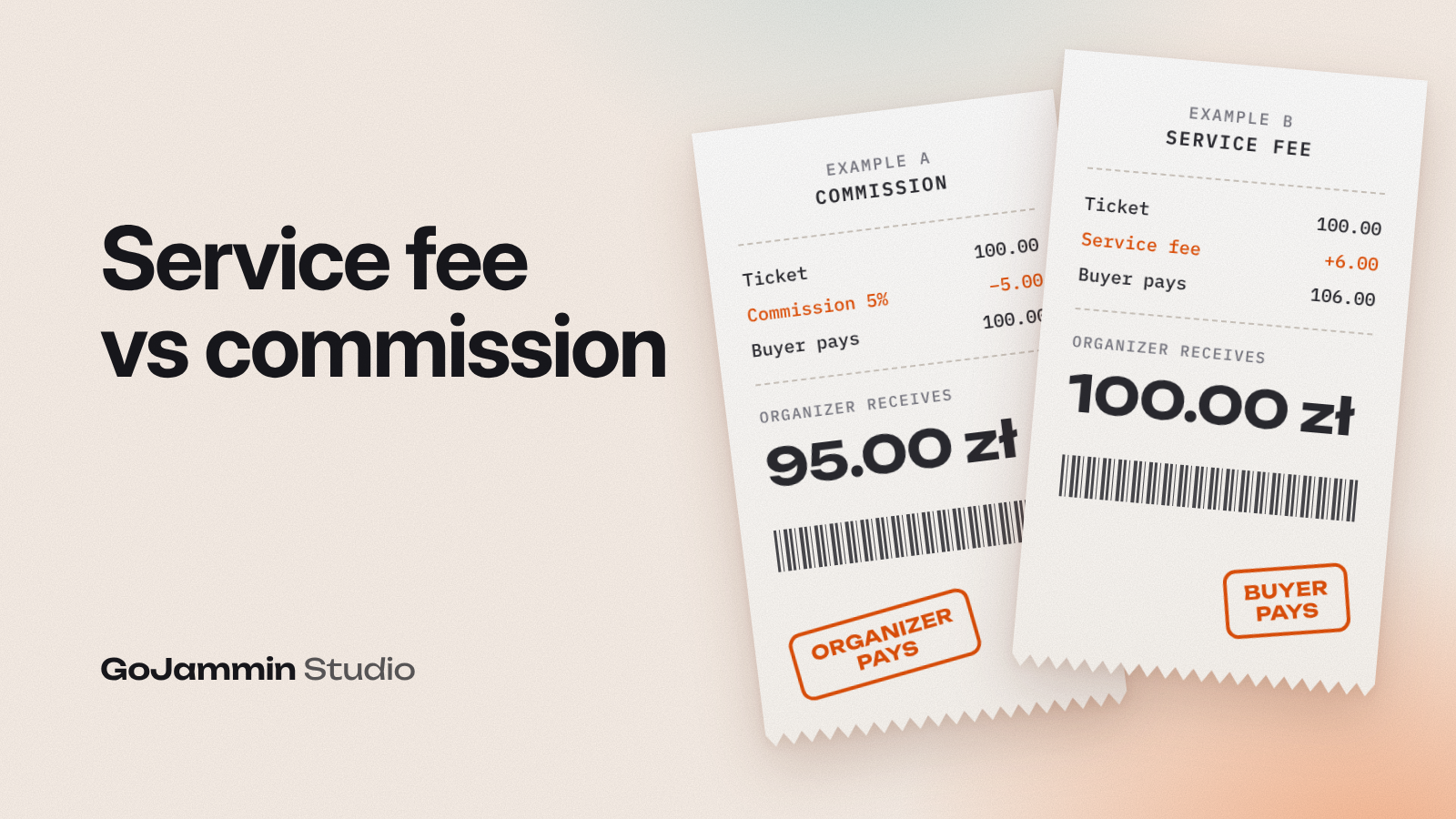
A ticketing platform's pricing page rarely tells you what a sale will cost. One platform quotes a commission, another a service fee, a third promises "no commission" and charges the buyer instead. The only comparison that holds is the difference between what the buyer pays and what the organizer receives after every fee on the same sale.
What is a ticket service fee?
A ticket service fee is a charge for handling the sale, added on top of the ticket price and paid by the buyer. What it covers is defined by the platform's pricing and terms: usually the order handling and the ticketing system, sometimes payment processing as well.
The same words appear in restaurants, airline bookings and utility bills, but here they refer only to event tickets. The labels do not carry over between platforms either: a "transaction fee" or "handling fee" on one site may cover something different from a "service fee" on another. Two questions settle what a fee actually is: does it include payment processing, and what amount is it calculated on?
How does a ticket service fee differ from commission?
Commission and a service fee are two ways of charging for the same work. Commission comes out of the organizer's proceeds: the platform deducts it from the buyer's payment before the money reaches the organizer. A service fee goes on top of the ticket price and is paid by the buyer. The models differ in who carries the cost of handling the sale.
Some platforms split the cost between both sides, for example a commission charged to the organizer and a separate payment fee charged to the buyer. This is why a "no commission" offer deserves a second look. It usually means that nothing is deducted on the organizer's side, not that selling is free: the buyer may be paying a service fee, or payment processing may be billed separately. Check exactly which charges the claim covers.
Who pays a ticket service fee?
The buyer pays a service fee. Commission is paid by the organizer, unless the platform allows it to be passed on, in which case it becomes part of the buyer's total. Whichever model you choose, the price shown to the buyer has to be the full one.
Under Polish consumer law, a mandatory fee must be included in the price presented to the buyer. An advertised price must not suggest that a ticket is available for an amount nobody can actually pay because an unavoidable charge is added later, and showing the fee only at checkout does not fix this. Poland's consumer protection authority spelled this out in its 2023 decision on eBilet, which required the platform to include its mandatory service fee in the minimum prices it displayed.
Before you choose a model, decide two numbers: the total the buyer will pay and the amount you need to receive. Then check that the event page, the promotional materials and the purchase form all show the same price.
How to calculate the real cost of selling tickets
The real cost of a sale is the difference between what the buyer pays in total and what the organizer receives after every fee charged on that sale.
Real cost = total paid by the buyer − amount received by the organizer
Base the comparison on the final settlement of the sale, not on a bank payout. A payout can be lower simply because part of the proceeds is still waiting to be transferred. Include charges that are invoiced separately, not only those deducted directly.
How much does selling a 100 zł ticket cost?
The three models below use a ticket with a base price of 100 zł. The figures are illustrative: each includes all charges assumed in that model, with no further VAT added, and none of them is the published rate of a specific platform.
| Model | Fee structure | Buyer pays | Organizer receives | Real cost of the sale |
|---|---|---|---|---|
| A | 5% commission paid by the organizer | 100 zł | 95 zł | 5 zł |
| B | 0% commission for the organizer + a 6 zł service fee paid by the buyer | 106 zł | 100 zł | 6 zł |
| C | 3% commission paid by the organizer + a 2.5% payment fee paid by the buyer | 102.50 zł | 97 zł | 5.50 zł |
In Model C, both percentages are calculated on the base ticket price of 100 zł.
Three models give three answers to "how much does it cost": 5 zł, 6 zł and 5.50 zł. In Model A the price stays at 100 zł and the cost comes out of the proceeds. In Model B the organizer keeps the full 100 zł and the buyer pays for the handling. Model C splits the cost between the two sides.
A real pricing table adds three more variables: tax on the fees, the calculation base and any minimum charge. A percentage calculated on the base ticket price gives a different result from the same percentage calculated on the buyer's total, which matters whenever commission is passed on to the buyer.
GoJammin Studio charges one commission: 3.7% of the gross ticket price + VAT, with a minimum of 1.50 zł per transaction. On a 100 zł ticket, if you absorb it, that is 3.70 zł net (4.55 zł with VAT), and you receive 95.45 zł. Stripe handles payments, and its fees are included in the commission, apart from the surcharges for cards issued outside the EEA and for currency conversion. The organizer decides whether to absorb the commission or pass it on to the buyer (for donation tickets it cannot be passed on). If you pass it on, the buyer pays 104.77 zł and you receive 100 zł; the commission is then 4.77 zł because it is calculated on the higher gross price. The conditions are set out in the Organizer Terms (in Polish).
Ready to run your own event?
Create your event on GoJammin and start selling tickets in minutes.
Create your eventOnline payment fees and ticket commission
Payment processing is the charge easiest to count twice. Add it to the commission only if the platform bills it separately; if the commission already includes processing, adding it again overstates the cost.
Also check what the quoted fee covers and which transactions carry surcharges, for instance foreign cards or currency conversion. Then establish the unit: do the percentage, the fixed part and the minimum apply per ticket, per order or per transaction? A minimum charged once per transaction and the same minimum charged on every ticket give very different results on an order of five tickets.
VAT on ticket sales commission
Check whether the quoted commission is net or gross. Where the standard Polish VAT rate applies to the service, it is 23%, but not every offer or cross-border transaction is treated the same way.
At 3.7% + VAT on a 100 zł ticket, with the commission absorbed by the organizer, the net commission is 3.70 zł. With 0.85 zł VAT, rounded to the nearest grosz, the gross charge is 4.55 zł. VAT on the commission is a separate matter from the VAT on the ticket itself.
A VAT-registered organizer can deduct input VAT to the extent that the purchased service is used for taxable activities, subject to statutory restrictions. With full deduction, your cost is the net 3.70 zł: 4.55 zł still comes off the sale, and you deduct the 0.85 zł VAT in your VAT return. The conditions are set out in Article 86 of Poland's VAT Act.
For B2B services supplied to an organizer established abroad, invoicing without Polish VAT and the reverse-charge mechanism depend on place-of-supply rules and the status of the parties. Confirm the treatment with your accountant.
What to check in a ticketing platform's pricing
Six questions cover most of what makes two offers hard to compare. Put them to each platform for the same sale: the same ticket price and the same number of tickets per order.
- Is the quoted fee net or gross, and which VAT treatment applies?
- Is there a fixed charge as well as a percentage, and does it apply per ticket, per order or per transaction?
- Is there a minimum commission, and what unit does the minimum apply to?
- Is payment processing included, and which surcharges can apply?
- Who pays the charge, and how does changing the payer affect the buyer's total price?
- When a buyer gets a refund, what happens to the commission and processing charges?
Frequently asked questions
Is a ticket service fee legal?
Yes, provided the applicable requirements are met, above all an accurate presentation of the full price. Article 12(1)(5) of Poland's Consumer Rights Act sets out the duty to inform the buyer about the price and costs, and Article 10(1) separately requires express consent for any payment beyond the agreed remuneration. Revealing a mandatory fee just before payment does not cure an earlier misleading price.
Is the service fee refunded with the ticket?
That depends on the reason for the refund, the contractual arrangements and the applicable law. Terms cannot override mandatory consumer rights. Check the buyer's entitlement separately from the platform's settlement with the organizer: the fact that the platform keeps its commission from the organizer does not, by itself, justify reducing the refund due to the buyer.
Can the organizer choose who pays the commission?
Yes, if the platform offers that choice. Check how the fee is calculated after the payer changes and what total price buyers then see. Also establish whether the setting applies to the whole event or to selected ticket types.
How much is a ticket service fee?
It depends on the platform and the offer; we compare specific platforms in our ticketing platform fee comparison. Pricing can combine a percentage, a fixed component and a minimum, with processing billed separately. Ask for a sample order settlement including VAT and all applicable surcharges.
Ready to run your own event?
Create your event on GoJammin and start selling tickets in minutes.
Create your event